Address
Toronto, Ontario
By appointment only / Online store only
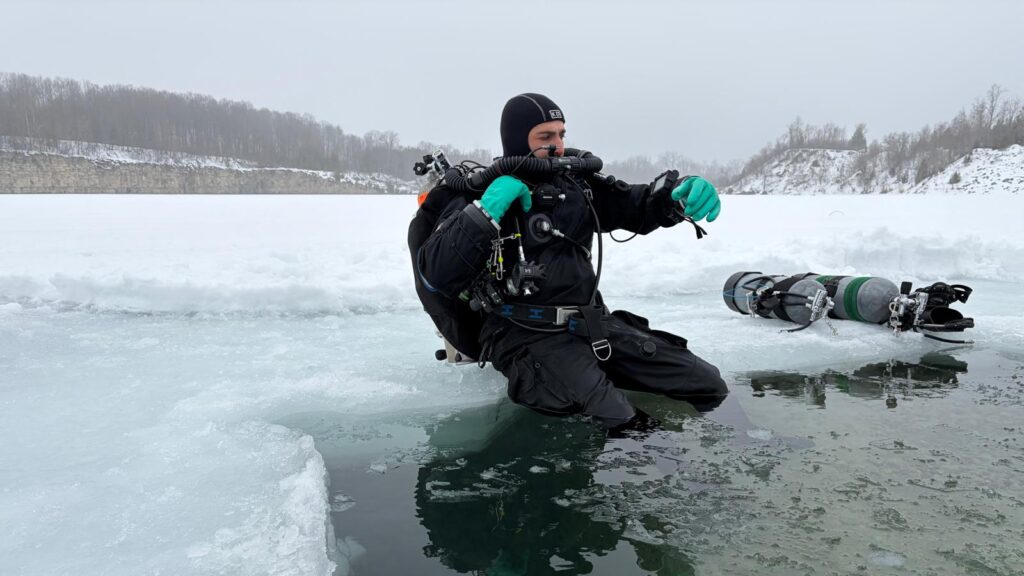
If you want to dive in Ontario beyond the warmest summer months, a drysuit isn’t optional — it’s essential. Lake Ontario water temperatures can drop to 4°C at depth even in August, and in winter can reach as low as 0°C. Most of Ontario’s best wreck sites sit in water cold enough to make a wetsuit uncomfortable or even dangerous on longer dives. Here’s everything you need to know about drysuit diving in Ontario.
A wetsuit works by trapping a thin layer of water against your skin, which your body heats. At depth, the neoprene compresses and loses insulating ability. In cold water, this means you get progressively colder as you go deeper.
A drysuit seals you completely from the water using wrist and neck seals. You stay dry, and the air space inside the suit (combined with thermal undergarments) provides insulation that doesn’t compress nearly as much at depth. The result: you can dive longer, deeper, and more comfortably in cold water.
Made from the same material as wetsuits but sealed at the wrists, neck, and zipper. They’re inherently warm and require less thermal undergarment, but they compress at depth (affecting buoyancy) and can be bulky. Best for divers who primarily dive in moderately cold water and don’t go very deep.
Made from thin, non-compressing material like trilaminate or crushed neoprene. They have virtually no inherent insulation — all warmth comes from the undergarment. The advantage is consistent buoyancy at any depth, lighter weight, easier donning and doffing, and a longer lifespan. This is the style preferred by most GUE and technical divers. Brands like Otter (available at Go Scuba Canada) are popular choices for Ontario diving.
Among membrane suits, trilaminate is the material most favoured by GUE and technical divers. It’s built from three bonded layers — usually a waterproof rubber core protected by outer fabric on each side. The big advantage is that it doesn’t compress at depth, so your buoyancy stays predictable whether you’re at 5 metres or 50. These suits also tend to be lighter and dry faster than neoprene alternatives, and if you get a tear, field repairs are relatively straightforward. When shopping for a trilaminate suit, prioritise features that make solo donning easier (like a telescoping torso), boots with enough flexibility to fin comfortably, and well-fitted wrist and neck seals.
Your drysuit keeps the water out — but it’s your undergarment that actually keeps you warm. Picking the right one is just as important as picking the right suit. How warm you need to be depends on how cold the water is, how long you’re staying down, and honestly, how well your body handles the cold. Keep in mind that water saps heat from your body roughly 25 times faster than air, so conditions that feel tolerable on the surface can become genuinely uncomfortable at depth.
Here’s what to look for in an undergarment:
Many experienced divers prefer layering several thinner garments rather than relying on one heavy piece. This gives you the flexibility to add or remove layers depending on conditions — a light setup for summer quarry dives and a heavier combination for winter wreck dives in 4°C water.
You lose a lot of heat through your head and neck, so a good hood makes a real difference in cold water. Go for one that’s snug enough to minimise water flushing but not so tight that it gives you a headache or makes it hard to equalise. You’ll also want one that lets trapped air escape easily — a pocket of air ballooning under your hood is annoying and affects your trim.
Wet gloves are the simpler, cheaper option — they’re tough and hard to damage, but your hands will get cold on longer dives and fine motor skills suffer. Dry gloves are the upgrade: much warmer, better dexterity, and they keep your hands completely dry. The downside is they’re more fragile (a thorn or sharp edge can puncture them), they take more care to put on properly, and most need a separate liner for warmth since the glove shell alone doesn’t insulate. Many dry glove systems attach to your suit with a ring mechanism that lets air flow between the suit and the glove, which helps keep your fingers warm.
If you’re doing dives longer than 45 minutes or so, a P-valve is worth considering. It’s a one-way valve installed in your suit that lets you urinate without ending the dive. More importantly, it removes the temptation to dehydrate yourself before diving — something that increases your risk of decompression illness. Options exist for both men and women.
Diving in a drysuit requires specific training because the suit adds buoyancy you need to manage. Key skills include:
One of the most important concepts to understand when diving a drysuit is how it fits into your overall buoyancy system. GUE divers configure their equipment as a “balanced rig” — meaning the weight of the system is adjusted so that a diver can manage two critical scenarios: swimming up from the bottom with a failed BC (wing) at the start of a dive when tanks are full, and holding a safety stop at 6 metres with near-empty tanks.
Your BC (wing) is always your primary buoyancy device. A drysuit is not a replacement for your wing — it provides supplementary buoyancy only. A drysuit might add roughly 1 kg of positive lift, which can reduce the effort of ascending without a functioning wing. However, relying too heavily on your drysuit for buoyancy creates instability, and overinflating it can lead to an uncontrolled ascent or gas escaping through pressurised seals.
The practical takeaway: when you set up your drysuit diving configuration, take the time to properly balance your rig. Test how much negative weight you can comfortably manage on ascent without your wing. Most divers can handle approximately 5 kg of negative ballast, but this varies from person to person. A properly balanced rig means less gas sloshing around inside your wing (which causes instability and drag), and a safer, more comfortable dive overall.
This is especially relevant in Ontario, where drysuit diving is the norm and many divers are also carrying additional equipment for deeper wreck or technical dives. Getting your weighting right from the start saves you problems underwater.
For divers who want to extend their bottom time in Ontario’s coldest water, battery-powered heated vests and undersuits are becoming increasingly popular. These are worn under your drysuit and use heating elements woven into the fabric to keep your core warm. Many experienced cold water divers consider them a game-changer, especially for longer dives or dives with extended decompression stops.
A heated vest is not a replacement for proper thermal undergarments — think of it as an additional layer. You should always dress warmly enough to complete your dive safely even if the heating system fails. A good heated vest also provides insulation on its own when turned off, so it functions as a useful layer regardless.
One important safety consideration: choose a system that keeps the battery canister outside your drysuit, connected to the vest through a bulkhead or thermovalve in your suit. This is the approach used by established diving brands and is considered best practice for good reason. If a battery malfunctions inside your drysuit, there is air (and therefore oxygen) trapped inside the suit, which can lead to burns or even a fire that you cannot escape while underwater. With an external battery, any malfunction happens in the water where it can be quickly disconnected or cut off. Divers have suffered serious burns from internal battery systems — it’s a risk that’s easy to avoid by keeping the battery outside.
A few more practical tips for using heated vests:
Take care of your suit and it’ll take care of you for years. Skip the maintenance and you’ll be dealing with leaky seals, stuck zippers, and expensive repairs. Here’s what good drysuit care looks like:
Realistically, for most Ontario diving outside of Brockville in July and August, you’ll want a drysuit. Even in summer, the thermocline on deeper dives can drop water temperatures to 4°C or below. In winter, water temperatures can reach 0°C. Many experienced Ontario divers use their drysuits year-round. If you’re planning to dive Tobermory’s deeper wrecks, Kingston’s schooners, or any site below 15 meters, a drysuit is the standard.